Caste and the church
How caste followed converts into the Telugu churches, 1700s–1930s: Catholic villages that kept caste, the Protestant debates of 1833, 1858 and 1867–68, the Brahmin converts of Robert Noble's school at Machilipatnam and their effect on the school, the quarrel over admitting Malas and Madigas to Noble's school, the distance between Mala and Madiga Christians, and the caste Hindu converts of the 1920s and 1930s who took communion from pastors of Mala and Madiga birth.
Download
Caste did not disappear when people became Christians. This page follows how the Telugu churches dealt with it, from the Catholic villages of the 18th century to the caste Hindu converts of the 1930s.12 Missionaries disagreed among themselves, and Indian Christians held their own views.34
About the sources. The debates are known mostly from missionaries’ letters and reports.35 Converts’ own views reach us mainly through them, as in the replies to Bishop Gell in 1867.6 See also Dalit history and Society and communities.
Catholic villages that kept caste
The Catholic Christians of the Guntur district kept their caste divisions.7 Gordon Mackenzie, the Kistna Collector, wrote in 1883 that Sudra Christians there did not marry other castes and never ate beef.1 He thought missionaries could not fairly forbid customs that were social rather than religious.1
He quoted Dr Heyne, who had written in 1814 that converts would come “in considerable numbers” if allowed to keep their castes.8 Mackenzie himself noted that some Protestants had wished to follow the Catholic way.1
The Protestant line, 1833 and 1858
Most Protestant leaders took the opposite view. In 1833 Bishop Daniel Wilson of Calcutta wrote that caste distinctions must be given up by converts, because the Gospel recognised none.910 An earlier bishop of Calcutta had feared that missionaries were stricter than needed.9
In 1858 Protestant missionaries of South India met at Ootacamund. They resolved that caste was “not a mere civil distinction, but emphatically a religious institution”, and “the monster evil of India”.5 They agreed to require its “unreserved and unequivocal renunciation” from converts.5 They also called on Christians to protest against any notice of caste in government acts.11
Mission schools faced the same question. At the Free Church of Scotland’s school at Nellore, the boys its missionary called “Pariah boys” had at first to sit on a separate bench.1213 When the school stopped this, according to that missionary, J. M. Mackintosh, a few Brahmin boys left, but within six months the attendance had doubled.13
Noble’s Brahmin converts at Machilipatnam
At Machilipatnam, Robert Noble’s school for high-caste boys made the CMS’s first Brahmin converts. The first came in 1847, two more in 1852 and three in 1855.14 Hibbert-Ware wrote that in the early years a baptism almost stopped the school, but later a Brahmin student could be baptised without trouble.14
The first conversions caused a riot. Mackenzie wrote that peons (guards) had to protect Noble’s house from “the angry mob”.15 After this, the Brahmin officials of the town supported a Hindu school of their own.16 See Hindu College, Machilipatnam and Responses to the missions.
Two of the early converts, Manchala Ratnam and A. Bhushanam, left Hinduism together.17 Noble trained them for the ministry, and both became pastors.18 Ratnam’s wife, married to him as a child, was brought back to him with the help of the family’s own Brahmin priest.17 In the Telugu prayer-book revision he insisted on pure Telugu idiom.19
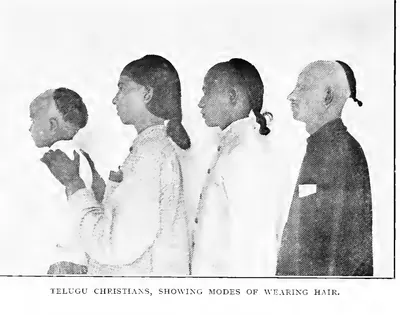
The converts gave up caste in practice. In 1867 the CMS missionary John Sharp wrote that the Brahmin converts had removed the tuft of hair and the sacred thread.20 Their meals were cooked by Mala servants, and some had married wives of lower castes.20 Ratnam and Bhushanam, by then ordained, approved his report.6
By 1876 the CMS noticed something odd: all its converts were either high-caste or Malas, with none from the castes between.14 By 1911 the staff of the Noble College included four Brahmin converts and five sons of Brahmin converts.21
Noble and the “pariah” boys, 1858
Noble himself kept low-caste boys out of his English school. In 1858 the CMS committee in Madras objected to his excluding “pariahs, leather-workers and scavengers”.22 Noble replied that pious English parents would not let their sons study with their servants.22
He wrote that it was “unreasonable and unchristian” to require Brahmins to sit “on the same form with the pariah and the sweeper” before teaching them.22 After nearly two years, the committee ruled that caste should be no ground for exclusion. It still treated Noble’s school as an exception, out of respect for him.22
Bishop Gell’s inquiry, 1867–68
In June 1867 the Bishop of Madras asked missionaries how far caste survived in their churches. The replies were printed in 1868.323 The Telugu replies differed:
- F. N. Alexander of Eluru wrote that the Brahmin convert G. Krishnayya and the Mala schoolmasters dined together at his house each month24
- he added that his agents ate rice cooked by the wife of a Chuckler (leather-worker) convert at Tyalapolu24
- W. Ellington of Raghavapuram said two of his Mala agents had accepted supper from a Chuckler Christian25
- J. Clay of the SPG at Kadapa wrote that his Mala agents had never eaten with the “Mathiga or Chuckler” caste, and would shrink from it4
Clay added that he had never made eating together a test of faith.4 Alexander, too, had set no such test, following Noble’s view that outward tests were useless while the heart was unchanged.3
Malas and Madigas in the churches
The gap between Mala and Madiga converts lasted. Hibbert-Ware wrote in 1912 that they did not marry, eat together or share wells, as Hindus or as Christians.26 He knew of no marriage between a Christian of Mala stock and one of Madiga stock.26
He told of a Madiga teacher who passed himself off as a Mala to serve a Mala congregation.27 When the people found out, they kept away from him, but did not complain, for fear that other Christians would shun them too.27 The SPG tried to give each congregation a teacher of its own caste.27 At the communion and in the boarding schools, it treated all alike.2728
Old feuds could reach the churches. In the Kadapa district, Madigas, sometimes urged on by Sudras, performed the insulting Chindu dance before Mala chapels.2829 Hibbert-Ware said Mala Christians “do feel it very keenly”, and teachers often had to stop fights.29
Some Indian leaders fought this division. In the CMS field, wrote T. Y. Darling, Mala Christians objected when the movement reached the Madigas, and some refused to eat beside them at a feast.3031 Pagolu Venkayya, the first Mala convert, ate food cooked by a Madiga in a Madiga Christian’s house.31 For this, Mala Christians drove him out of the village where he was stationed, though they later said they were sorry.31 See Pagolu Venkayya.
Caste outsiders, too, objected to Madigas. At Ongole in 1867 some caste people asked for baptism, but refused to share a church with Madigas.32 Clough baptised the Madigas anyway, and the caste people stayed away.33 In 1921 the Hyderabad census writer found that some enumerators had still entered Indian Christians as Malas or Madigas, and he ordered this corrected.34
In 1922 a CMS delegation, which had toured the Telugu field, wrote about caste in all its mass-movement fields.3536 It did not name particular castes. It warned that when two communities long “at enmity” came in together, the old hostility tended to enter the church.35 It was worse, it said, when neighbouring missions each took a different caste, for then “the separation is complete and permanent”.35
The delegation asked clergy and church councils to “rigorously suppress” caste in church matters, such as refusing to worship together or to accept a pastor of other birth.3537 But it advised against forcing changes in eating, drinking and marrying, which it called social customs.37 It also warned that labels such as “mass movement Christians” might “soon come to mean low caste”.3835
Caste Hindu converts
A few caste Hindu converts came early. The Reddi convert Ramiah of Razupalem sat in school beside small boys and later lived as a Christian teacher in his own village.3940 Purushottam Chaudhari threw away his sacred thread in 1833.41 But at Dummagudem the Koya converts would not accept Malas in the same church, and many left.42
From the 1920s larger groups of Sudras joined (see Mass movements). Pickett was told that they were baptised by pastors of Mala or Madiga birth, and took communion from their hands.432 In the Methodist field in the north of Hyderabad State, some high-caste converts took Mala and Madiga preachers into their homes and ate with them.43
Old habits remained. Sudra converts often sat together by caste in church, and where one cup was used at communion, they liked to drink first.244 In over nine villages in ten they came to churches in the Mala and Madiga quarters.45 Most married within their own caste, and Christians in general still objected to marriages across castes.44
Where the sources disagree
Should missions tolerate caste? Mackenzie (1883), a Collector, thought the Catholic missionaries right not to forbid social customs.1 The Protestant conference of 1858 called caste a religious evil to be renounced.5 Downie (1893) blamed Catholics and “even some Protestants” for pandering to caste.32
Should converts be tested by eating together? Alexander and Ellington reported that their agents ate with Chuckler Christians.2425 Clay chose not to require it, and said his agents would refuse.4
Footnotes
-
Mackenzie, Kistna District (1883), p. 280 (archive.org (opens in a new tab)). ↩ ↩2 ↩3 ↩4 ↩5
-
Pickett, Christian Mass Movements (1933), pp. 303–304 (archive.org (opens in a new tab)). Paraphrased. ↩ ↩2 ↩3
-
Inquiries Made by the Bishop of Madras regarding the Removal of Caste Prejudices and Practices in the Native Church (1868), p. 143, reply of F. N. Alexander, Ellore, 20 July 1867 (archive.org (opens in a new tab)). ↩ ↩2 ↩3 ↩4
-
Inquiries Made by the Bishop of Madras (1868), p. 149, reply of J. Clay, Cuddapah, 17 July 1867 (archive.org (opens in a new tab)). ↩ ↩2 ↩3 ↩4
-
Proceedings of the South India Missionary Conference, held at Ootacamund (1858), p. 294, “Resolutions on Caste” (archive.org (opens in a new tab)). ↩ ↩2 ↩3 ↩4
-
Inquiries Made by the Bishop of Madras (1868), p. 148 (archive.org (opens in a new tab)). ↩ ↩2
-
Gordon Mackenzie, A Manual of the Kistna District (1883), p. 279 (archive.org (opens in a new tab)). ↩
-
Mackenzie, Kistna District (1883), p. 281 (archive.org (opens in a new tab)). ↩
-
Joseph Roberts (comp.), Caste, in its Religious and Civil Character, Opposed to Christianity (1847), p. 5, letters of Bishop Heber and of Bishop Daniel Wilson (5 July 1833) (archive.org (opens in a new tab)). ↩ ↩2
-
Roberts, Caste Opposed to Christianity (1847), p. 6 (archive.org (opens in a new tab)). ↩
-
Proceedings of the South India Missionary Conference (1858), p. 295 (archive.org (opens in a new tab)). ↩
-
M. A. Sherring, The History of Protestant Missions in India, 1706–1881 (1884), p. 410 (archive.org (opens in a new tab)). ↩
-
Sherring, Protestant Missions in India (1884), p. 411 (archive.org (opens in a new tab)). ↩ ↩2
-
Hibbert-Ware, Christian Missions in the Telugu Country (1912), p. 185 (archive.org (opens in a new tab)). ↩ ↩2 ↩3
-
Mackenzie, Kistna District (1883), p. 286 (archive.org (opens in a new tab)). ↩
-
Mackenzie, Kistna District (1883), p. 370 (archive.org (opens in a new tab)). ↩
-
S. Satthianadhan (comp.), Sketches of Indian Christians (1896), p. 53, “Rev. M. Ratnam Garu” (archive.org (opens in a new tab)). ↩ ↩2
-
Satthianadhan, Sketches of Indian Christians (1896), p. 54 (archive.org (opens in a new tab)). ↩
-
Satthianadhan, Sketches of Indian Christians (1896), p. 55 (archive.org (opens in a new tab)). ↩
-
Inquiries Made by the Bishop of Madras (1868), p. 147 (archive.org (opens in a new tab)). ↩ ↩2
-
Hibbert-Ware, Christian Missions in the Telugu Country (1912), p. 186 (archive.org (opens in a new tab)). ↩
-
Mackenzie, Kistna District (1883), p. 287 (archive.org (opens in a new tab)). ↩ ↩2 ↩3 ↩4
-
Inquiries Made by the Bishop of Madras (1868), p. 146, reply of J. Sharp, Masulipatam, 25 September 1867, to the circular of 7 June (archive.org (opens in a new tab)). ↩
-
Inquiries Made by the Bishop of Madras (1868), p. 144 (archive.org (opens in a new tab)). ↩ ↩2 ↩3
-
Inquiries Made by the Bishop of Madras (1868), p. 145, replies of Alexander and of W. Ellington, Raghavapuram (archive.org (opens in a new tab)). ↩ ↩2
-
G. Hibbert-Ware, Christian Missions in the Telugu Country (1912), p. 90 (archive.org (opens in a new tab)). ↩ ↩2
-
Hibbert-Ware, Christian Missions in the Telugu Country (1912), p. 91 (archive.org (opens in a new tab)). ↩ ↩2 ↩3 ↩4
-
Hibbert-Ware, Christian Missions in the Telugu Country (1912), p. 92 (archive.org (opens in a new tab)). ↩ ↩2
-
Hibbert-Ware, Christian Missions in the Telugu Country (1912), p. 93 (archive.org (opens in a new tab)). ↩ ↩2
-
T. Y. Darling, A Telugu Convert: The Story of P. Venkayya (1893), p. 22 (HathiTrust (opens in a new tab)). ↩
-
Darling, A Telugu Convert (1893), p. 23 (HathiTrust (opens in a new tab)). ↩ ↩2 ↩3
-
Downie, The Lone Star (1893), p. 81 (archive.org (opens in a new tab)). ↩ ↩2
-
Downie, The Lone Star (1893), p. 82 (archive.org (opens in a new tab)). ↩
-
Census of India, 1921, Vol. XXI: Hyderabad State, Part I, Report (1923), p. 91 (archive.org (opens in a new tab)). ↩
-
CMS, Delegation to India (1922), p. 94 (HathiTrust (opens in a new tab)). ↩ ↩2 ↩3 ↩4 ↩5
-
CMS, Delegation to India (1922), p. 139 (HathiTrust (opens in a new tab)). ↩
-
CMS, Delegation to India (1922), p. 95 (HathiTrust (opens in a new tab)). ↩ ↩2
-
Church Missionary Society, Report of the Church Missionary Society’s Delegation to India, 1921–1922 (1922), p. 93 (HathiTrust (opens in a new tab)). ↩
-
David Downie, The Lone Star: The History of the Telugu Mission of the American Baptist Missionary Union (1893), p. 70 (archive.org (opens in a new tab)). ↩
-
Downie, The Lone Star (1893), pp. 71–72 (archive.org (opens in a new tab)). ↩
-
John Craig and others (eds.), Telugu Trophies (1924), p. 172, “Chowdhari Purushottam” (archive.org (opens in a new tab)). ↩
-
Hibbert-Ware, Christian Missions in the Telugu Country (1912), p. 192 (archive.org (opens in a new tab)). ↩
-
J. Waskom Pickett, Christian Mass Movements in India (1933), p. 299 (archive.org (opens in a new tab)). All rights reserved; paraphrased. ↩ ↩2
-
Pickett, Christian Mass Movements (1933), p. 304 (archive.org (opens in a new tab)). Paraphrased. ↩ ↩2
-
Pickett, Christian Mass Movements (1933), p. 302 (archive.org (opens in a new tab)). Paraphrased. ↩
Photos
References
Notes (0)
Sources (13)
Spotted an error on this page? Tell us
Last updated: