Pagolu Venkayya
Pagolu Venkayya (about 1809–1891), a Mala leader of Raghavapuram in the Krishna district, was baptised by the CMS missionary T. Y. Darling in 1859. His search for 'the great God', his baptism with his family and friends, and his preaching began the Christian movement among the Malas of the Krishna and Godavari villages.
Download
Pagolu Venkayya was a Mala of Raghavapuram, a village about twenty-eight miles from Vijayawada (then Bezwada).1 He was baptised in 1859, and his conversion began the Christian movement among the Malas of the CMS field.23 The CMS missionary J. Barton called him “the father of the Telugu village Churches”.4
Early life
The missionary T. Y. Darling worked out his age from Venkayya’s own account. Venkayya said he was born two years before a great comet, and was a young man in the famine of 1832; Darling placed his birth about 1809.5 Hibbert-Ware wrote that in his youth Venkayya was known for daring and led a band of violent men.1
Seeker after God
About 1856 a friend told Venkayya that a missionary had called idols made by the village carpenter powerless.61 Venkayya gave up the idols and prayed: “O great God! Who art Thou? Where art Thou? Show Thyself to me.”7 He learned more from a tract read aloud in his village, since he could not then read.7
In 1859 he walked twenty-eight miles to the Sivaratri festival at Vijayawada, hoping to find a missionary there.6 By Hibbert-Ware’s account a Brahmin pointed him to the mission house.8 After hearing Darling, he said: “This is my God, this is my Saviour.”3
Baptism and opposition
Darling went to Raghavapuram to teach the inquirers. Brahmins, for whom many of the Malas worked, complained to the magistrate and threatened to cut his tent ropes.9 In March 1859 Darling baptised Venkayya, his wife, their five children and other men.310 Before the baptism the men cut off their tufts of hair, after a dream Venkayya described.11
Preacher
Venkayya went with Darling on tours and preached among his own people.12 He found reading hard and needed glasses, but had a strong memory.12 Some of the first inquirers in other villages, such as Polsanapalle near Eluru, were his relatives.34
Caste inside the church
Darling’s book of 1893 tells how the movement later spread from the Malas to the Madigas, and how this tested the new Christians.1314 Some Mala Christians objected to eating beside Madiga Christians at a feast, and some drew back.14 Venkayya defended the Madigas’ place at the feast, and then went further: he ate food cooked by a Madiga, in a Madiga Christian’s house.14
He paid for it. The missionary J. Stone wrote that Mala Christians drove Venkayya out of the village where he was stationed, because he had eaten with Christians of Madiga origin on Whit Sunday.14 Stone said they later regretted it, and that Venkayya forgave them.14 At another village, Gundapilly, a man struck Venkayya from behind with a heavy stick while he argued about religion, and he was carried away unconscious.14
The well at Raghavapuram
In the early years, Darling wrote, the washerman would not wash the Christians’ clothes, and the Komati (grocer) would not sell them grain or oil.15 The Malas could not use the village’s only good well, which belonged to the caste people.15 When Darling’s servant, a caste man, tried to draw water for him, the Brahmins turned him away and took a complaint to the magistrate.1516
Years later an old Brahmin sold the Christians a site for a church, at night, before others could object, and Venkayya advanced the money.17 Another old Brahmin told them of a forgotten well in that field, and it gave good water.18 In the famine of 1876 every other well in the village went dry.19 Caste people then asked to use the Christians’ well, and Venkayya and the others let them share it until the rains came.1920
Last years
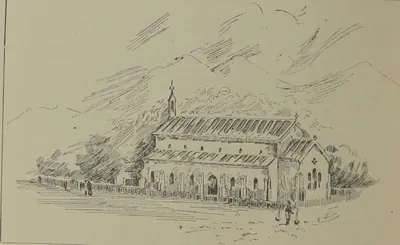
On 9 April 1883 Venkayya and the missionary’s wife, Mrs Stone, laid the first stone of St Mark’s church at Raghavapuram.21 It opened on 5 March 1885.21 Stone reported that in his seven years there the baptised Christians of the district rose from 680 to 1,115.21
He died on Sunday morning, 20 September 1891.22 By then, wrote Hibbert-Ware, the CMS Telugu converts had grown from 200 to nearly 10,000.3 Bishop Henry Whitehead, writing in 1924, gave him as an example of how mass movements began with one person of “unusual spiritual insight”.23
Where the sources disagree
How many were baptised with him? Hibbert-Ware lists his wife, five children and sixteen other men.3 Darling’s own words, “the remaining men, sixteen in all”, may mean sixteen people altogether.10
Footnotes
-
Hibbert-Ware, Christian Missions in the Telugu Country (1912), p. 188 (archive.org (opens in a new tab)). ↩ ↩2 ↩3
-
G. Hibbert-Ware, Christian Missions in the Telugu Country (1912), p. 187 (archive.org (opens in a new tab)). ↩
-
Hibbert-Ware, Christian Missions in the Telugu Country (1912), p. 190 (archive.org (opens in a new tab)). ↩ ↩2 ↩3 ↩4 ↩5 ↩6
-
J. Barton, preface to T. Y. Darling, A Telugu Convert: The Story of P. Venkayya (1893), p. 3 (HathiTrust (opens in a new tab)). ↩ ↩2
-
Darling, A Telugu Convert (1893), p. 5 (HathiTrust (opens in a new tab)). ↩
-
Darling, A Telugu Convert (1893), p. 8 (HathiTrust (opens in a new tab)). ↩ ↩2
-
Darling, A Telugu Convert (1893), p. 9 (HathiTrust (opens in a new tab)). ↩ ↩2
-
Hibbert-Ware, Christian Missions in the Telugu Country (1912), p. 189 (archive.org (opens in a new tab)). ↩
-
Darling, A Telugu Convert (1893), p. 17 (HathiTrust (opens in a new tab)). ↩
-
Darling, A Telugu Convert (1893), p. 19 (HathiTrust (opens in a new tab)). ↩ ↩2
-
Darling, A Telugu Convert (1893), p. 18 (HathiTrust (opens in a new tab)). ↩
-
Darling, A Telugu Convert (1893), p. 20 (HathiTrust (opens in a new tab)). ↩ ↩2
-
Darling, A Telugu Convert (1893), p. 22 (HathiTrust (opens in a new tab)). ↩
-
Darling, A Telugu Convert (1893), p. 23 (HathiTrust (opens in a new tab)). ↩ ↩2 ↩3 ↩4 ↩5 ↩6
-
Darling, A Telugu Convert (1893), p. 24 (HathiTrust (opens in a new tab)). ↩ ↩2 ↩3
-
Darling, A Telugu Convert (1893), p. 25 (HathiTrust (opens in a new tab)). ↩
-
Darling, A Telugu Convert (1893), p. 26 (HathiTrust (opens in a new tab)). ↩
-
Darling, A Telugu Convert (1893), p. 27 (HathiTrust (opens in a new tab)). ↩
-
Darling, A Telugu Convert (1893), p. 28 (HathiTrust (opens in a new tab)). ↩ ↩2
-
Darling, A Telugu Convert (1893), p. 29 (HathiTrust (opens in a new tab)). ↩
-
Darling, A Telugu Convert (1893), p. 31 (HathiTrust (opens in a new tab)). ↩ ↩2 ↩3
-
Darling, A Telugu Convert (1893), p. 32 (HathiTrust (opens in a new tab)). ↩
-
Henry Whitehead, Indian Problems in Religion, Education, Politics (1924), p. 70 (archive.org (opens in a new tab)). ↩
Photos
References
Notes (0)
Sources (3)
Spotted an error on this page? Tell us
Last updated: