Phirangipuram
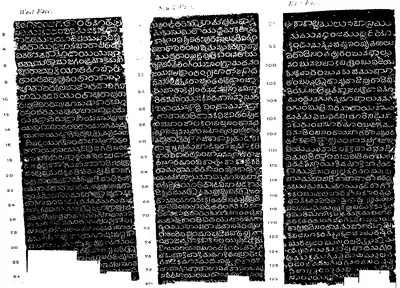
Village near Guntur, two miles from the Kondavidu hills. A pillar in front of its Virabhadra temple bears a verse inscription of 1410, composed by Srinatha. It describes the Santana-sagara tank built by Suramamba, queen of the Reddi king Peda Komati Vema.
Download
Phirangipuram lies in the old Sattenapalli taluk of the Guntur district, close to the Kondavidu hills.1 J. Ramayya’s account of 1912 describes it as a station on the Vijayawada (then Bezwada)–Guntakal railway.1
Robert Sewell passed that way in the early 1880s.2 He noted that the level country “between the hill fort and the road to Faringipuram abounds in remains of archaeological interest”.2 At Phirangipuram itself there was a Roman Catholic establishment about two hundred years old.2 Some roughly carved slabs lay near the church.2 They were said to have been brought from Kondavidu.2
The tank inscription
A stone pillar in front of the temple of Virabhadra carries a verse inscription in Sanskrit and Telugu.13 It records the dedication of a tank called Santana-sagara in February 1410.13 The tank was built by Suramamba, queen of the Reddi king Peda Komati Vema.13 The last verse names the poet Srinatha as composer.13
At Aminabad, about two miles away, a verse inscription of 1415 records that Racha Vema dug a channel to feed his mother’s tank.456 Ramayya believed that this was the Santana-sagara tank.456 See the Phirangipuram inscription and Srinatha.
Footnotes
-
J. Ramayya, Three Inscriptions of the Reddis of Kondavidu, Epigraphia Indica XI (1911–12), p. 313 (archive.org (opens in a new tab)). ↩ ↩2 ↩3 ↩4 ↩5 ↩6
-
Robert Sewell, Lists of the Antiquarian Remains in the Presidency of Madras, Vol. I (1882), Appendix, p. xi (archive.org (opens in a new tab)). ↩ ↩2 ↩3 ↩4 ↩5
-
Ramayya, Three Inscriptions of the Reddis of Kondavidu (1911–12), p. 314 (archive.org (opens in a new tab)). ↩ ↩2 ↩3 ↩4
-
J. Ramayya, Madras Museum Plates of Vema, A.D. 1345, Epigraphia Indica VIII (1905–06), p. 13 (archive.org (opens in a new tab)). ↩ ↩2
-
V. Rangacharya, A Topographical List of the Inscriptions of the Madras Presidency, Vol. II (1919), p. 835, Guntur No. 766 (archive.org (opens in a new tab)). ↩ ↩2
-
Rangacharya, Topographical List, Vol. II (1919), p. 838, Guntur No. 803 (archive.org (opens in a new tab)). ↩ ↩2
Photos
References
Notes (0)
Sources (4)
Spotted an error on this page? Tell us
Last updated: