Chendalur
Chendalur was formerly in Ongole taluk. It appears as Chendalura in a Pallava grant of Kumaravishnu II and as Chendapura in an Eastern Chalukya grant of 673. Both sets of copper plates were found here in a buried pot of paddy husk during house construction.
Download
Chendalur was a village of the Ongole taluk, then in the Nellore district, when E. Hultzsch edited its copper plates in 1906.1 G. Jouveau-Dubreuil gave the name as Chandaluru, in the Ongole taluk of the Guntur district.2
Two grants of one village
Hultzsch described how two sets of copper plates were found together at Chendalur.13 A ryot (farmer) digging the foundations of his house had found them buried in a pot of paddy husk.13 This was some forty years before they reached Hultzsch.13
One is the Sanskrit grant of the Pallava king Kumaravishnu II, issued from Kanchipura.4 It gives a field in Chendalura in Karmmanka-rashtra.4 The other is a grant of the Eastern Chalukya king Sarvalokasraya, dated to 673, giving the whole village of Chendapura in Kamma-rashtra to six Brahmans. Hultzsch took both names to mean Chendalur itself.5 See the Chendalur plates.
Hultzsch noticed that some phrases praising the kings in the Chalukya grant had been borrowed from Pallava records.3 He explained that the Pallavas had been “supplanted by the Eastern Chalukyas”.3 The Nellore gazetteer of 1942 took Sarvalokasraya’s grant as evidence of Eastern Chalukya rule in the district in his time.6
Footnotes
-
E. Hultzsch, “Chendalur Plates of Kumaravishnu II”, Epigraphia Indica VIII (1905–06), p. 233 (archive.org (opens in a new tab)). ↩ ↩2 ↩3 ↩4
-
G. Jouveau-Dubreuil, The Pallavas (1917), p. 16 (archive.org (opens in a new tab)). ↩
-
E. Hultzsch, “Chendalur Plates of Sarvalokasraya; A.D. 673”, Epigraphia Indica VIII (1905–06), pp. 236–237 (archive.org (opens in a new tab)). ↩ ↩2 ↩3 ↩4 ↩5
-
Hultzsch, “Chendalur Plates of Kumaravishnu II” (1906), p. 234 (archive.org (opens in a new tab)). ↩ ↩2
-
Hultzsch, “Chendalur Plates of Sarvalokasraya” (1906), p. 238 (archive.org (opens in a new tab)). ↩
-
Gazetteer of the Nellore District, brought up to 1938, Vol. A (1942), p. 34 (archive.org (opens in a new tab)). ↩
Photos
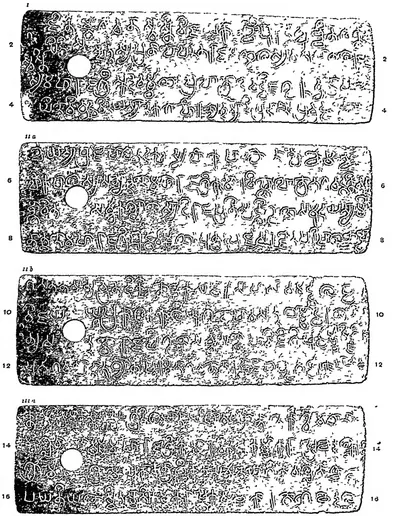 "Chendalur plates of Kumaravishnu II", plates i, ii a, ii b and iii a (Epigraphia Indica VIII, plate with No. 23 (PDF p. 295))Inscription rubbing · 1906
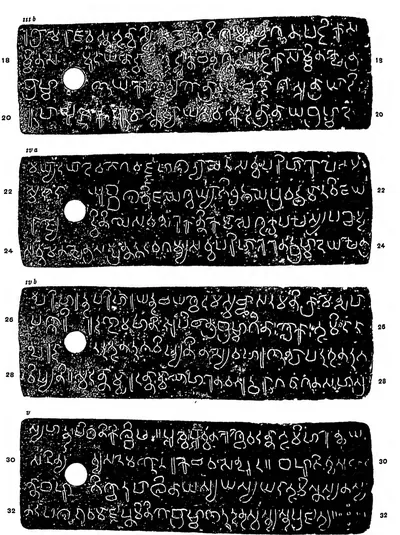 "Chendalur plates of Kumaravishnu II", plates iii b, iv a, iv b and v (Epigraphia Indica VIII, plate with No. 23 (PDF p. 296))Inscription rubbing · 1906
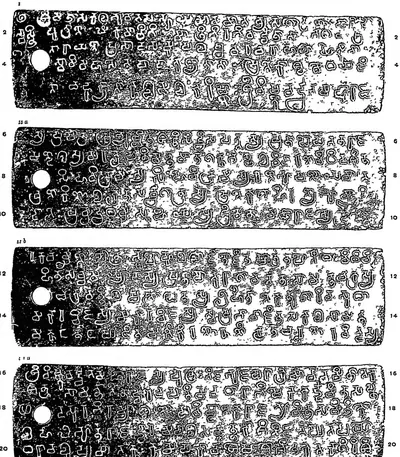 "Chendalur plates of Sarvalokasraya.—A.D. 673", plates i, ii a, ii b and iii a (Epigraphia Indica VIII, plate between pp. 238 and 239 (PDF p. 301))Inscription rubbing · 1906
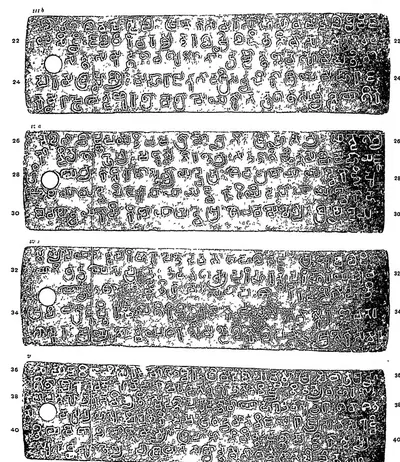 "Chendalur plates of Sarvalokasraya.—A.D. 673", plates iii b, iv a, iv b and v (Epigraphia Indica VIII, plate between pp. 238 and 239 (PDF p. 302))Inscription rubbing · 1906
References
Notes (0)
Sources (3)
Spotted an error on this page? Tell us
Last updated: