Mir Alam tank inscription (1806)
A short dated inscription appears on a black basalt reservoir stone at Hyderabad's Mir Alam tank. It records the completion of the water works in AH 1221 (1806), under Sikandar Jah, by his minister Mir Alam. Bilgrami (1927) prints the text in Arabic script and translates it: 'In the name of God it flows and thank God it stands firmly. In the year 1221 A.H.'
Download
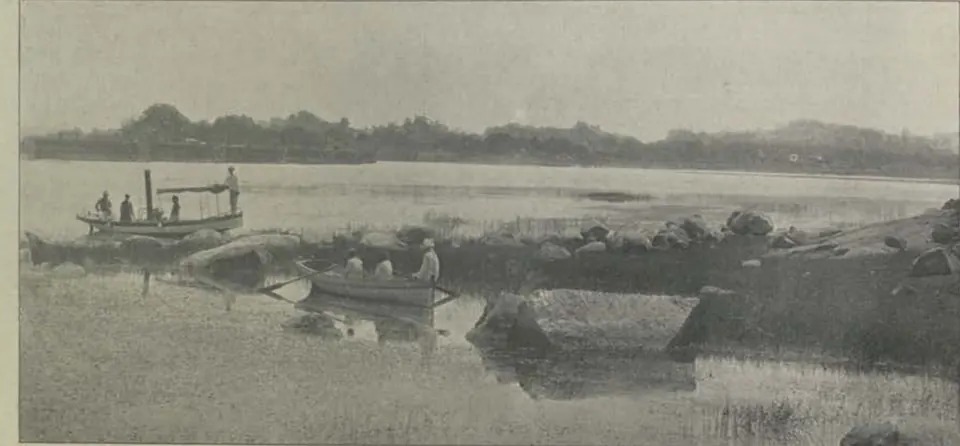
This inscription is the only dated record of the Mir Alam tank. The minister Mir Alam built this reservoir south-west of Hyderabad in the reign of the Asaf Jahi Nizam Sikandar Jah. Syed Ali Asgar Bilgrami published the inscription in 1927 in Landmarks of the Deccan.1 The book surveys archaeological remains in the city and its suburbs.1 This inscription appears as entry No. 41, “Mir Alam Bund”.1
The text
Bilgrami says the inscription is set “on the reservoir stone of black basalt”.1 The stone is on “one of the reservoirs wherefrom the water is distributed”.1 Bilgrami prints the single line in Arabic script, followed by this translation:1
“In the name of God it flows and thank God it stands firmly. In the year 1221 A.H.”1
He gives the date as “Asaf Jah III’s reign 1221 A.H. (1806 A.D.)”.1 Bilgrami found the inscription in good condition and recommended protecting it.1 In 1927 the bund belonged to the estate of Nawab Salar Jang.1 No other edition or plate of the inscription was found in the sources consulted.
Building the tank
According to Bilgrami, the bund, or dam, was built near Kotwalguda and the Isa river.1 He names its builder as Mir Abul Qasim Khan, known as Mir Alam Bahadur, who was Sikandar Jah’s prime minister.1 Two of his grandsons supervised the work.1 The tank and bund together cost Rs 8,00,000.1
The Imperial Gazetteer of 1909 credits the dam to “French engineers in the Nizam’s service”.2 According to the gazetteer, Mir Alam paid for it with his share of the prize money from Srirangapatna (then Seringapatam).2 Bilgrami adds that Mir Alam had led the Nizam’s forces in the war with Tipu Sultan in 1799.3
Footnotes
-
Syed Ali Asgar Bilgrami, Landmarks of the Deccan (1927), p. 106 (archive.org (opens in a new tab)). ↩ ↩2 ↩3 ↩4 ↩5 ↩6 ↩7 ↩8 ↩9 ↩10 ↩11 ↩12 ↩13 ↩14
-
Imperial Gazetteer of India: Hyderabad State (1909), p. 118 (archive.org (opens in a new tab)). ↩ ↩2
-
Bilgrami, Landmarks of the Deccan (1927), p. 107 (archive.org (opens in a new tab)). ↩
Photos
References
Notes (0)
Sources (2)
Spotted an error on this page? Tell us
Last updated: