Mellacheruvu inscription of Prataparudra's reign
This Telugu inscription records a gift to the local Shiva temple by the Velamas and all the people of Mellacheruvu in Huzurnagar taluk. Dated January 1312, it lists land and levies on grain, merchants, weavers and shepherds. The villagers acted on the authority of a royal officer's nayamkara holder, who held villages in return for military service.
Download
The stone
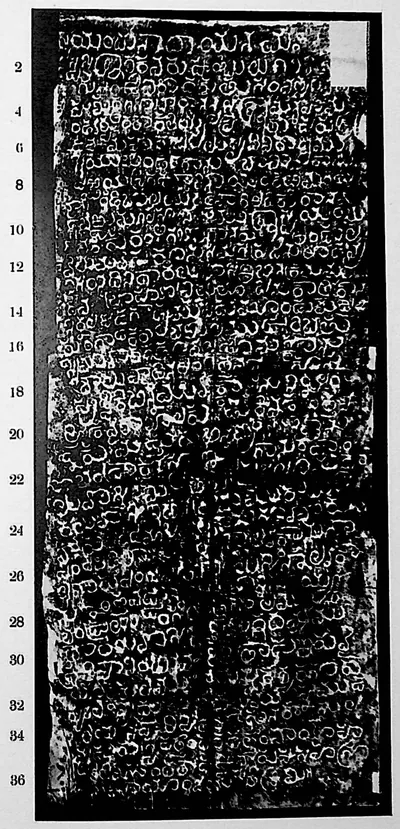
The inscription is cut on a stone slab in the Svayambhudeva temple at Mellacheruvu, in the Huzurnagar taluk of the old Nalgonda district.1 P. Sreenivasachar edited it in 1940 as No. 26 of his Corpus of Inscriptions in the Telingana Districts, with a plate.1 It is a short record in Telugu prose.2
Contents
The record is dated Saka 1233 (Saka is an Indian way of counting years), the year Virodhikrit, on the first day of the bright half of Magha, a Monday.2 The inscription names the reigning king as the Kakatiya Prataparudra, with the title mahamandaleshvara (great provincial lord).2
Mamdu Nagi-Radi Bollaya-reddi held the nayamkara (villages held in return for military service, explained below) of Bomiraju Erraya-pregada.21 With Bollaya-reddi’s authority, the Velamas and all the villagers poured gift-water before the god.21 Their gift supported worship of Mellacheruvu’s Svayambhudeva, the god of the mulasthana (main shrine).21
The gift had several parts. The Brahmins received thirteen shares (marturus) of wet land, measured with the pedda-gadyamu.21
There was also a contribution of one chinnamu for each putti of grain sown on the land of the village in all four directions.2 This covered black soil and white, including the king’s own land (racha-polamu).2 Wet land ploughed and sown in the two seasons of Karttika and Vaishakha paid one chinnamu for each marturu.2
The rest of the people made yearly gifts:31
Sreenivasachar compared these yearly levies to a professional tax.1 He dated the record to Monday, 10 January 1312.4
Significance
P. V. Parabrahma Sastry cited the record in his discussion of land ownership.5 Sastry pointed out that the levy applied to every kind of land around the village, including government land called racha-polamu.5 He took this as a sign that the land of a village ultimately belonged to the king.5
The record is also an example of the nayamkara system.62 According to Parabrahma Sastry, Kakatiya kings used this system from Rudramadevi’s time onward.62 They gave nayakas (military chiefs) villages instead of a salary.62 In return the nayakas kept troops for the king’s service.62 For the reign, see Prataparudra.
Editions
The text and translation are in Sreenivasachar’s Corpus, Part II (1940), pp. 88–90, with the date on p. 179 and the list entry on p. 190.14
Footnotes
-
P. Sreenivasachar (ed.), A Corpus of Inscriptions in the Telingana Districts, Part II (1940), p. 190, list of inscriptions, No. 26 (archive.org (opens in a new tab)). Paraphrased. ↩ ↩2 ↩3 ↩4 ↩5 ↩6 ↩7 ↩8 ↩9 ↩10 ↩11 ↩12
-
Sreenivasachar, Corpus, Part II (1940), p. 89, translation, lines 1–23 (archive.org (opens in a new tab)). Paraphrased; the terms are those of the inscription. ↩ ↩2 ↩3 ↩4 ↩5 ↩6 ↩7 ↩8 ↩9 ↩10 ↩11 ↩12 ↩13 ↩14
-
Sreenivasachar, Corpus, Part II (1940), p. 90, translation, lines 23–37 (archive.org (opens in a new tab)). Paraphrased. ↩ ↩2 ↩3 ↩4
-
Sreenivasachar, Corpus, Part II (1940), p. 179, appendix of dates, No. 17 (archive.org (opens in a new tab)). Paraphrased. ↩ ↩2
-
Parabrahma Sastry, The Kakatiyas of Warangal (1978), p. 200. ↩ ↩2 ↩3
-
P. V. Parabrahma Sastry, The Kakatiyas of Warangal (1978), p. 195. ↩ ↩2 ↩3 ↩4
Photos
References
Notes (0)
Sources (2)
Spotted an error on this page? Tell us
Last updated: